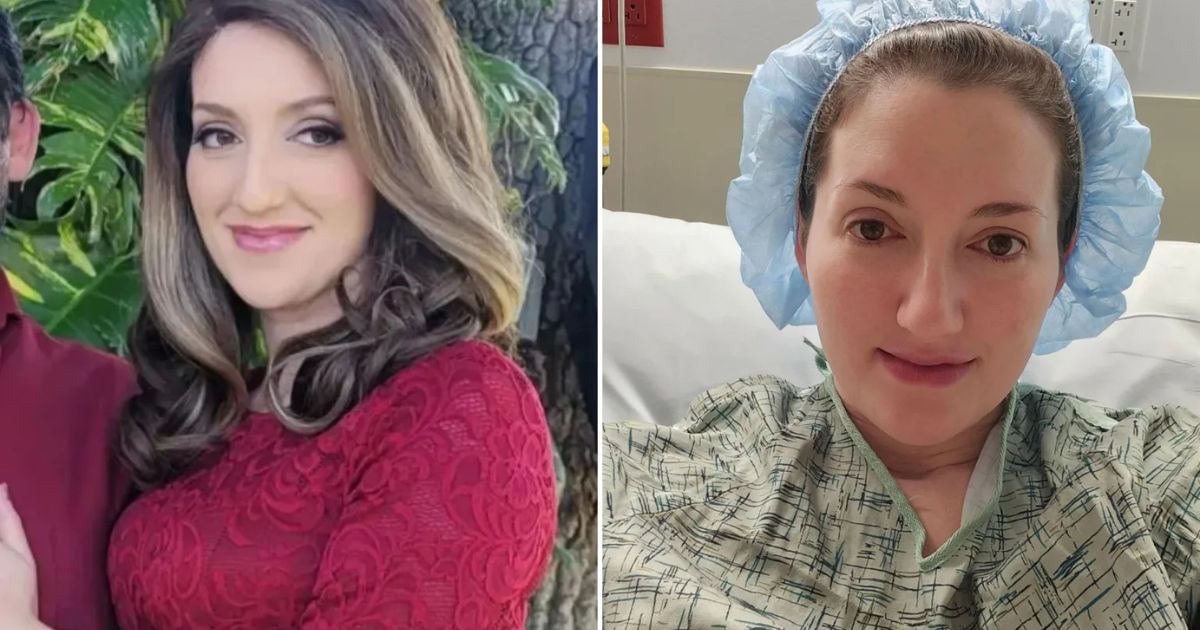
A routine hospital visit for what seemed like a manageable medical issue turned into a life-threatening ordeal for a young mother, who says she “died” twice during surgery and survived against overwhelming odds.
Hinda Abrahams, a 28-year-old teacher from Kansas, initially sought medical attention after experiencing several days of abdominal pain and bleeding. Despite taking birth control consistently and having recently had a normal menstrual cycle, she suspected something more serious could be wrong. After four days of symptoms, her husband, Theodore, urged her to go to the hospital.
Shortly after arriving, a pregnancy test confirmed her fears. Doctors identified a suspected ectopic pregnancy — a condition in which a fertilized egg implants outside the womb — along with a mass near her left ovary. She was scheduled for what was expected to be a straightforward laparoscopic procedure.
Surgery Takes a Life-Threatening Turn
The procedure, anticipated to last under an hour, quickly escalated into a medical emergency. Less than 20 minutes after surgery began, doctors informed her husband that her heart had stopped twice during the operation.
According to Hinda, the cardiac arrests were caused by an anaphylactic allergic reaction to the general anaesthesia. She later learned that her heart had stopped for approximately 20 seconds.
“When I woke up, I immediately recognised an ICU room,” she recalled. “Then I saw the time and realised hours had passed since the operation started. I knew it wasn’t good.”
She regained consciousness in intensive care, intubated and unable to breathe on her own. Medical staff had performed CPR to revive her, leaving her with chest pain from the compressions. She was connected to multiple lines delivering medication and support.
Reflecting on the experience, Hinda said she had not fully understood the risks associated with cardiac arrest and resuscitation. She noted that survival rates can be low even in medical settings, making her recovery all the more extraordinary.
Doctors monitored her closely over the following days, as she developed pneumonia from intubation and showed signs of heart failure caused by the trauma of the incident. She remained in intensive care for three days.
Despite the severity of the complications, Hinda survived without any lasting life-altering injuries — something she describes as a “miracle.”
Her experience has since become a powerful reminder of how quickly medical situations can escalate, even in controlled environments, and how critical rapid response and care can be in life-threatening emergencies.